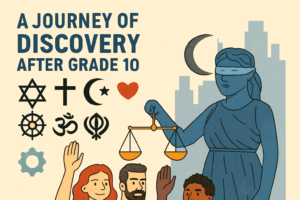
A Journey of Discovery After Grade 10 — For Curious Students Who Want to Learn, Not Just Earn.
Most education systems assume a simple equation: study, degree, job. But not every student fits into this equation.
Some students are driven by a deeper impulse: a genuine curiosity about how the physical, chemical, and biological world works. They want to understand nature, not monetize it. They are not running away from careers; they are simply running toward knowledge itself.
This article is written for such a student. It explains how to study science seriously after class 10, where to enroll, what to avoid, and—most importantly—how to build real scientific understanding without being crushed by exam culture. It also provides direct learning resources, so curiosity can immediately turn into action.
A Necessary Truth About Education Systems
Modern education systems are career-oriented by design. Their primary goal is employability, not understanding. This does not mean they are useless for a curious learner, but it does mean they must be approached carefully.
Formal education is best used as a framework—it gives discipline, timelines, and exposure. But genuine understanding must be built alongside it through self-directed learning. A curious student should neither reject the system completely nor surrender fully to it. The correct approach is parallel learning.
Should a Curious Student Choose Science in Classes 11–12?
Yes, but with the right mindset.
Studying science in classes 11 and 12 introduces the language of science, mathematical thinking, and the idea that nature follows discoverable laws. For a curiosity-driven learner, this stage should be treated as a foundation rather than a final goal.
Physics, Chemistry, and Mathematics are essential. Biology should also be studied, either formally or independently. The learning environment matters more than the board itself. Systems that allow time, questioning, and flexibility are far healthier than coaching-dominated ecosystems focused purely on ranks.
The aim here is mental space, not competition.
What to Avoid
Certain educational environments actively suppress curiosity. These include institutions that reward memorization over understanding, coaching cultures obsessed with speed and shortcuts, and classrooms where asking “why” is discouraged.
A curious mind needs slowness, reflection, and intellectual freedom. When learning becomes only about marks and ranks, curiosity gradually suffocates.
The Core Principle: Parallel Self-Education
The real education of a curiosity-driven student happens outside textbooks and examinations.
A self-designed curriculum should run parallel to formal studies and focus on deep understanding rather than fast coverage. This parallel path is not optional—it is the heart of this journey.
Physics: Learning How Nature Behaves
Physics teaches how nature behaves using models, logic, and mathematics. It is the backbone of scientific thinking.
A student should begin with classical ideas such as motion, force, and energy, then move toward electricity, magnetism, waves, and thermodynamics. More abstract areas like quantum mechanics and relativity should be approached conceptually first, without haste.
One of the most important resources here is The Feynman Lectures on Physics. These lectures do not present physics as a finished product but as a living process of reasoning and questioning. They are ideal for a curious learner who wants to know why physics works.
🔗 The Feynman Lectures on Physics (free online)
https://feynmanlectures.caltech.edu
For structured university-level learning, MIT OpenCourseWare (OCW) is invaluable. It offers free courses with lecture notes, videos, assignments, and solutions across physics and other sciences.
🔗 MIT OpenCourseWare
https://ocw.mit.edu
For students in India, NPTEL Physics courses, created by IITs and IISERs, provide excellent conceptual teaching at an undergraduate level, including topics like mechanics, electromagnetism, thermodynamics, and modern physics.
🔗 NPTEL Courses
https://onlinecourses.nptel.ac.in
To build intuition before depth, CrashCourse Physics on YouTube offers short, engaging explanations that help students see the big picture before diving deeper.
Additional visual tools such as PhET Interactive Simulations and The Physics Classroom are extremely helpful for visual learners and experimental intuition.
Chemistry: Understanding How Matter Organizes Itself
Chemistry is often reduced to reaction lists, but in reality it explains how matter prefers to arrange itself and how energy governs change.
A meaningful approach begins with atomic structure and chemical bonding, then moves into thermodynamics, equilibria, and reaction kinetics. Organic chemistry should be approached as a logical system rather than a memorization exercise.
MIT OpenCourseWare – Chemistry provides free, high-quality courses in general, organic, and physical chemistry.
🔗 MIT OCW – Chemistry
https://ocw.mit.edu/courses/chemistry/
NPTEL Physical Chemistry courses are especially strong for understanding thermodynamics, electrochemistry, and kinetics in a systematic way.
🔗 NPTEL Courses
https://onlinecourses.nptel.ac.in
For clarity and conceptual grounding, CrashCourse Chemistry offers short, engaging videos that connect ideas across topics.
Supplementary reading such as That’s the Way the Cookie Crumbles by Joe Schwarcz helps connect chemistry to everyday life and keeps curiosity alive beyond equations.
Biology: The Logic of Life
Biology becomes deeply meaningful when understood as physics and chemistry organized by information.
Instead of memorizing terms, a student should ask how cells manage energy, how genetic information is stored and expressed, and why evolution produces complexity rather than chaos. Starting with cell biology and biochemistry builds a strong base for genetics, evolution, and systems thinking.
MIT OpenCourseWare – Biology offers free courses covering cell biology, genetics, and evolution.
🔗 MIT OCW – Biology
https://ocw.mit.edu/courses/biology/
CrashCourse Biology provides clear, engaging introductions to biological systems and processes.
For deeper thinking beyond textbooks, The Selfish Gene by Richard Dawkins explains evolutionary logic with clarity, while What Is Life? by Erwin Schrödinger explores biology from a physicist’s perspective. Both help students think conceptually, not mechanically.
Mathematics: The Quiet Foundation of All Science
Without mathematics, science becomes storytelling. With it, ideas become precise.
A curious student does not need extreme abstraction early on but must master algebra, trigonometry, calculus, and basic probability. Mathematics should be learned as a tool for understanding science, not as an isolated subject.
Khan Academy is excellent for building strong foundations through guided lessons and practice.
🔗 Khan Academy
https://www.khanacademy.org
For deeper study, MIT OpenCourseWare – Mathematics offers university-level courses in calculus, linear algebra, and differential equations.
🔗 MIT OCW – Mathematics
https://ocw.mit.edu/courses/mathematics/
Tools like GeoGebra are helpful for visualizing mathematical ideas interactively.
Philosophy of Science: Protecting the Mind from Dogma
A serious science learner must reflect on how science itself works. What counts as evidence? What are the limits of explanation? How do scientific revolutions occur?
Reading Karl Popper on falsifiability, Thomas Kuhn on paradigm shifts, and Einstein’s essays on science and philosophy helps prevent science from becoming blind belief. Philosophy does not weaken science; it sharpens it.
These works should be read slowly and reflectively, alongside scientific study.
Additional Enrichment (Optional but Powerful)
Modern science is increasingly computational. Learning Python for scientific thinking helps students simulate systems, analyze data, and think algorithmically. Introductory resources such as Python for Everybody are good starting points.
As understanding deepens, students can explore real research through open-access journals and preprint servers like arXiv, PLOS, and eLife, where cutting-edge science is freely available.
A Sustainable Learning Strategy
In the short term, students can build foundations using CrashCourse and Khan Academy.
In the medium term, MIT OCW and NPTEL courses provide structured, serious learning.
In the long term, deep textbook reading, problem solving, simulations, and small projects should be balanced carefully.
Understanding grows through doing, not just reading.
Conclusion: Returning to the Original Spirit of Science
A person who studies science purely to understand reality stands closer to the original spirit of science than many professionals.
This path demands independence, humility, and long-term dedication. Science, at its core, is not merely a career option; it is a way of seeing the world.