
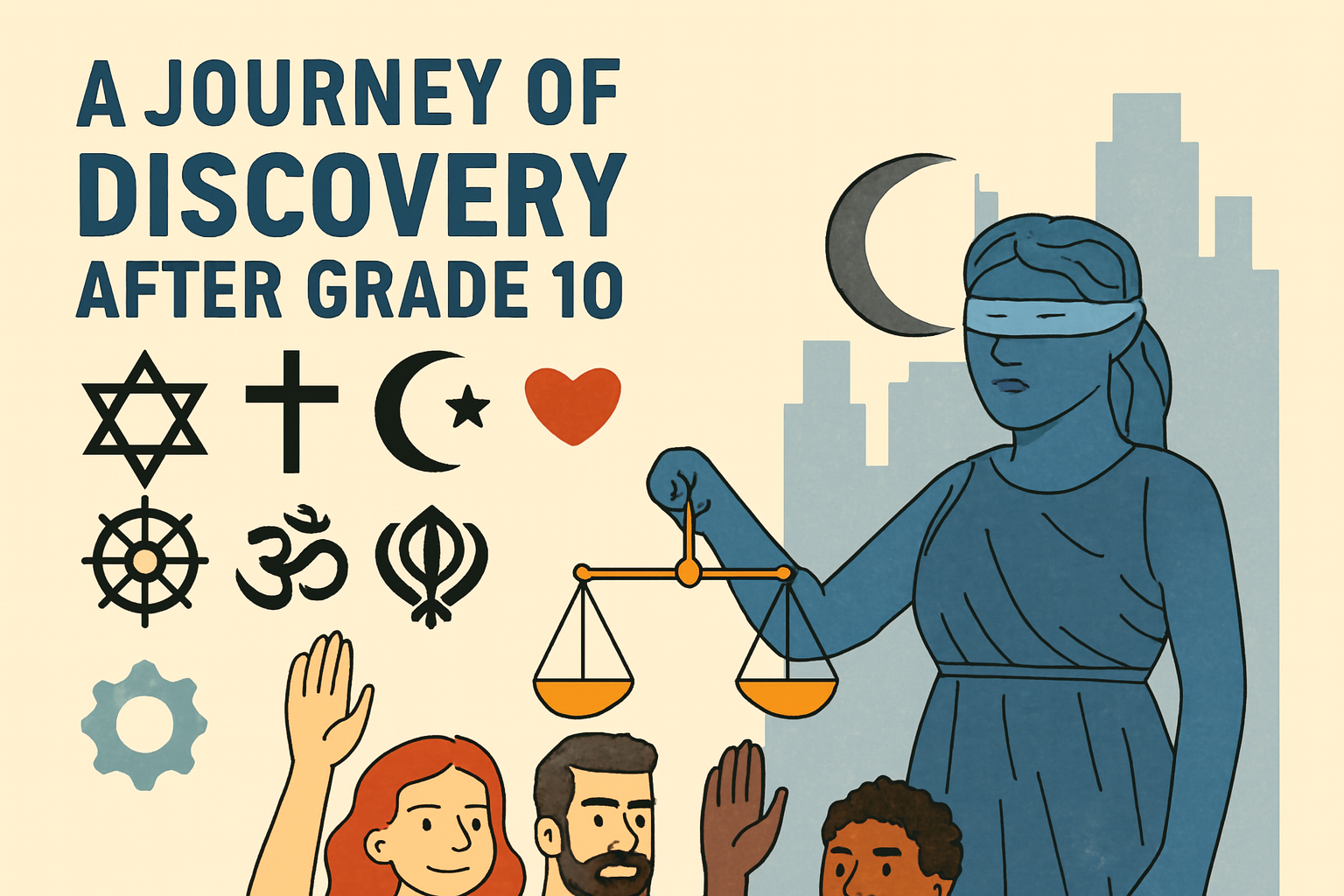
Justice is a concept that every human society struggles to define, enforce, and experience. Across time and geography, people have observed a striking contradiction: some wrongdoers escape punishment while innocent people suffer without redress. Courts fail, power corrupts, and death often arrives before accountability. This persistent gap between moral expectation and worldly reality has prompted civilizations to look beyond the immediate and visible, developing faith-based systems that ensure justice transcends human limitations. The intuition is compelling: if justice truly ends at death, then reality itself appears unjust. This idea is not merely a philosophical abstraction; it is a structural necessity. Without the promise of ultimate justice, moral behavior would seem optional or arbitrary.
Faith and Law: Complementary Foundations
Faith and law, though often treated as separate forces, historically emerged as complementary solutions to this problem. Faith addresses ultimate questions: what is right and wrong, whether moral order is real, and whether injustice ultimately matters. Law addresses practical questions: which behaviors should be permitted or forbidden, how society should regulate conduct, and what consequences humans can enforce here and now. Faith provides the moral grounding for law, while law translates faith into enforceable social norms. Even in secular societies, law relies on faith-like assumptions about fairness, justice, and human dignity. Without faith, law risks becoming mere power; without law, faith risks remaining idealistic and ineffective.
Justice Beyond Death: A Universal Belief
Because human justice is incomplete, most civilizations developed the belief that justice continues beyond death. Ancient Egyptians imagined judgment before Osiris, Greeks placed wrongdoers in Tartarus, and Hinduism and Buddhism conceived karma operating across lifetimes. Judaism, Christianity, and Islam formalized post-death judgment, where every action is accounted for. Despite differences in terminology—judgment, karma, resurrection—the core conviction is universal: death does not release wrongdoers from accountability. This belief preserves meaning for victims, warns oppressors, and ensures that moral actions are ultimately consequential.
Balancing Justice and Human Action
If all justice were deferred to the afterlife, faith could easily degenerate into fatalism or passivity. Civilizations therefore developed a balancing principle: this world is not the final court, but that does not excuse inaction. Justice exists, but it is often invisible, delayed, or partially human-administered. Life is a test, karma unfolds over time, and cosmic order operates beyond immediate perception. This framework allows moral choice to exist, preserves human agency, enables mercy, and restrains human arrogance.
The danger arises when faith is misinterpreted to justify inaction. People may excuse oppression, poverty, or discrimination by saying it is “karma,” “destiny,” or “God’s will.” Historical examples abound. In parts of India, caste oppression was reinforced by misreading karma, portraying social hierarchy as a divine order and discouraging intervention. This misuse of faith leads to stagnation and oppression. However, the faith traditions themselves, if correctly interpreted, actively reject such distortions.
Hinduism: Karma Explains, Dharma Commands
Hinduism, one of the oldest continuous religions in the world, provides a clear illustration. Classical Hindu philosophy distinguishes sharply between karma, which explains circumstances, and dharma, which governs duty and action. The Bhagavad Gita emphasizes:
“You have a right to work only, but never to its fruits. Let not the fruits of action be your motive, nor let your attachment be to inaction.” (Bhagavad Gita 2:47)
Here, Krishna instructs Arjuna to act against injustice, even though doing so is difficult, risky, and may result in suffering. Karma explains the past but does not absolve present responsibility. Social roles (varna) in the Gita are defined by qualities and actions, not birth. Later rigid interpretations that enforced caste hierarchy contradicted these core principles. Saints such as Kabir, Ravidas, Chaitanya, and Basava openly rejected caste-based discrimination, demonstrating that the faith itself demands action to oppose injustice.
A modern parallel can be found in the work of social activist Dr. B.R. Ambedkar, who challenged caste-based discrimination and worked to create a legal and educational framework that empowered marginalized communities. His efforts were guided not merely by political motives, but by a deep commitment to dharma—the moral duty to fight injustice.
Buddhism: Compassion Without Excuse
Buddhism reinforces a similar principle. The Buddha explicitly warned against explaining all suffering as the result of past karma, emphasizing that doing so undermines compassion and ethical responsibility. As the Dhammapada states:
“Hatred is never appeased by hatred in this world. By non-hatred alone is hatred appeased. This is a law eternal.” (Dhammapada 5)
Monks and lay practitioners are morally obligated to intervene when harm is occurring, feed the hungry, care for the sick, and protect the vulnerable. Karma provides context but never serves as a moral excuse for inaction. Contemporary examples include Buddhist organizations aiding refugees in Myanmar and other conflict zones, acting to reduce suffering regardless of any idea of karmic deserts.
Islam: Responsibility Within Divine Decree
Islamic theology makes a sharp distinction between Qadr (divine decree) and human responsibility. Oppression is explicitly condemned, and believers are urged to act to reduce harm. The Prophet Muhammad emphasized:
“Tie your camel first, then trust in God.”
This principle underscores the balance between human effort and divine outcome: individuals must take practical responsibility to prevent or mitigate harm, even while accepting that the ultimate result rests with God. Modern examples include Islamic humanitarian organizations providing aid in war-torn regions or supporting victims of discrimination, acting to reduce harm without claiming control over all outcomes.
Christianity and Judaism: Dignity and Action
Christianity and Judaism similarly emphasize human action alongside faith in divine justice. The New Testament repeatedly stresses the moral imperative to help the oppressed:
“Truly I tell you, whatever you did for one of the least of these brothers and sisters of mine, you did for me.” (Matthew 25:40)
Judaism teaches:
“Do not stand idly by while your neighbor’s blood is shed.” (Leviticus 19:16)
Faith here mandates intervention when injustice occurs. Accepting exploitation or social exclusion as divinely ordained would contradict the core teachings. Modern examples include organizations like Habitat for Humanity, inspired by faith-based ethics, which actively work to provide housing and dignity to marginalized communities, acting on moral responsibility rather than waiting for divine intervention.
Modern Social Issues: Caste Discrimination Today
Caste discrimination persists in contemporary society, affecting access to education, employment, housing, and social dignity. Though it may be rationalized as karmic fate or tradition, it is actively occurring, and harm is preventable. Faith, when correctly interpreted, demands intervention. Social reform, advocacy, education, and support for marginalized communities are morally required. Silence, neutrality, or passive acceptance constitutes moral failure, even if individuals believe they are respecting cosmic order.
Yet believers must also recognize the limits of their influence: entrenched social systems, resistant institutions, or unpredictable consequences of activism may not yield immediate success. One must act diligently but surrender the ultimate outcomes to divine justice, karma, or cosmic order. This balance ensures that action is moral while maintaining humility and patience.
When the Balance Fails
From Moral Responsibility to Moral Overreach: Where the Tension Shifts
Once faith has established the duty to act against present injustice, a deeper and more dangerous question emerges: where does rightful action end, and moral overreach begin? History shows that the same moral urgency that drives reform can, if unbounded, transform into a belief that humans themselves must complete justice across time—correcting the past, punishing historical wrongs, or avenging suffering long after its original agents are gone. At this point, the problem is no longer inaction, but excess action—action driven not by duty but by anger, identity, or the desire to dominate moral narratives. Faith traditions anticipate this shift and respond with equal clarity: just as surrendering all justice to fate corrupts morality, so does assuming total authority over justice. The question therefore evolves from whether humans must act to how far humans may go. It is at this precise boundary—between responsibility and vengeance, reform and retribution—that faith draws its firmest moral lines.
Limits of Human Vengeance: Historical, Generational, and Symbolic
A related but deeper moral hazard arises when individuals or groups attempt to “correct” past injustices through vengeance—whether against descendants, historical figures, or cultural symbols. Across societies, humans repeatedly attempt to punish the past by tearing down statues, demonizing historical personalities, erasing traditions, humiliating descendants, or engaging in symbolic violence against communities associated with earlier wrongs. While the psychological impulse is understandable—pain seeks meaning and closure—faith traditions universally warn that the past cannot be morally repaired through present-day vengeance. Justice operates within time; vengeance attempts to dominate time. When people claim, “It is my duty to punish historical oppressors,” they assume a self-appointed cosmic authority. All major faiths explicitly reject this assumption, not to protect injustice, but to prevent moral chaos.
Hinduism: Dharma Is Present Action, Not Retroactive Punishment
In Hinduism, karma is a subtle and multi-lifetime unfolding governed by cosmic law, not a tool placed in human hands. No scripture authorizes humans to retroactively “correct” karma by punishing history, ancestors, or symbols of the past. The Mahabharata repeatedly illustrates that unresolved grievances accumulated across generations do not restore balance but multiply destruction. Even the Kurukshetra war is portrayed as a tragic necessity arising from present injustice—not as a moral celebration of vengeance for ancient wrongs. Krishna’s guidance to Arjuna is precise: act according to present dharma, not historical resentment. The Bhagavad Gita clarifies this moral restraint:
“One who sees action in inaction and inaction in action is wise among men.” (Gita 4:18)
This wisdom lies in knowing when not to act, even when injustice existed in the past. Saints and reformers such as Kabir, Ravidas, and Swami Vivekananda warned that hating one’s ancestors, demonizing history, or weaponizing inherited guilt weakens society rather than purifies it. Hindu thought insists on learning from the past, reforming present systems, and protecting the vulnerable—while rejecting symbolic or generational vengeance as adharma rooted in ego (ahamkara).
Judaism: Remembering Suffering Without Reproducing It
Judaism draws a sharp distinction between remembrance and retaliation. Jewish tradition preserves historical trauma—most notably slavery in Egypt—not as fuel for revenge, but as a moral warning against repeating oppression in any form. Memory in Judaism is ethical, not punitive. The Torah explicitly rejects collective or inherited guilt and commands restraint in moral judgment:
“You shall not oppress a stranger, for you know the soul of the stranger.” (Exodus 23:9)
Justice in Judaism must be lawful, proportional, and directed at actual wrongdoing—not symbolic substitutes. Punishing descendants, humiliating communities, or enacting revenge against history itself is viewed not as justice, but as a betrayal of covenantal ethics.
Christianity: Rejecting the Moral Illusion of Retaliatory Power
Christianity goes further by explicitly dismantling the moral legitimacy of vengeance itself. While acknowledging injustice and suffering, it consistently warns that retaliation—especially against the past—destroys both the victim and the avenger. Jesus’ teachings reject the idea that humans may cleanse history through force:
“Put your sword back in its place, for all who take the sword will perish by the sword.” (Matthew 26:52)
Christian ethics permit resistance to injustice, protection of the vulnerable, and reform of corrupt systems—but categorically reject punishment of the dead, inherited guilt, and moral absolutism applied across generations. Historical reckoning is permitted only when it leads to repentance, reconciliation, and healing, not humiliation or erasure.
Islam: Justice Without Hatred or Excess
Islamic moral law (Shariah) strictly limits justice to what is proportionate, intentional, and directed at actual wrongdoing. The Qur’an repeatedly forbids collective punishment and warns against allowing historical anger to become moral license:
“Let not the hatred of a people cause you to act unjustly.” (Qur’an 5:8)
Islam allows accountability, restitution, and defense against oppression, but it forbids vengeance driven by rage, symbolism, or inherited blame. Punishing descendants, destroying cultural memory, or claiming divine authority to avenge history violates the Qur’anic principle that each soul bears only its own burden.
Applying the Faith Framework: Justice With Limits
When the limits of human vengeance are properly understood, a shared moral test emerges across traditions. Before acting, one must ask: Is injustice occurring now? Can my action reasonably reduce harm without creating new injustice? Does it protect the innocent rather than symbolically punish the past? Am I motivated by duty rather than anger, identity, or moral domination? If the answer is yes, faith demands action. If the action seeks to avenge history, humiliate communities, or assert cosmic authority, faith demands restraint. Moral responsibility includes knowing not only when to act, but when action itself becomes a violation.
Conclusion: Justice With Courage, Restraint, and Humility
Faith traditions do not protect injustice—they expose it. They do not sanctify suffering—they demand responsibility. But they also do not authorize humans to punish history, avenge the dead, or weaponize inherited guilt. Across Hinduism, Judaism, Christianity, Islam, and Buddhism, the guidance converges: act decisively against present injustice, reform unjust systems, and protect the vulnerable—while surrendering ultimate judgment to God, dharma, or divine order.
Applied to modern issues such as caste discrimination, refugee crises, historical trauma, or systemic inequality, this balance is crucial. Societies collapse not only from injustice, but from vengeance mistaken for justice. Moral maturity lies in the harder path: healing without hatred, reforming without erasing, remembering without retaliating, and acting courageously without claiming omniscience. In this balance lies not only social stability, but the integrity of faith itself.