
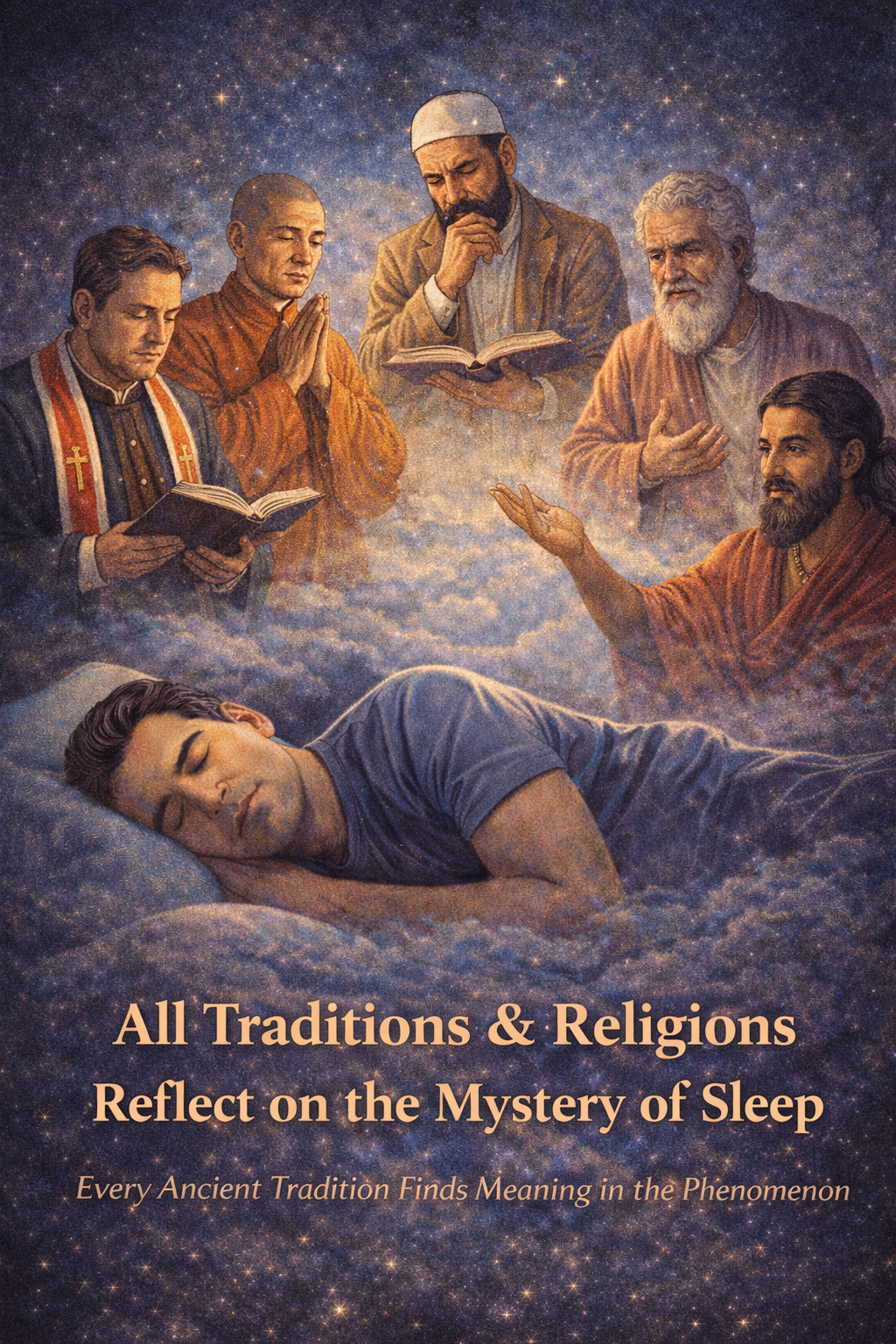
Sleep has occupied a unique place in philosophy because it temporarily removes conscious awareness without destroying life or identity. Unlike death, sleep is reversible; unlike wakefulness, it suspends control, perception, and deliberate thought. For this reason, philosophers across civilizations treated sleep as a window into the deeper nature of the soul, the self, and truth itself. What emerges from these reflections is not a single doctrine, but a shared realization: consciousness and existence are not the same, and awareness operates in layers.
Sleep as a Philosophical Problem
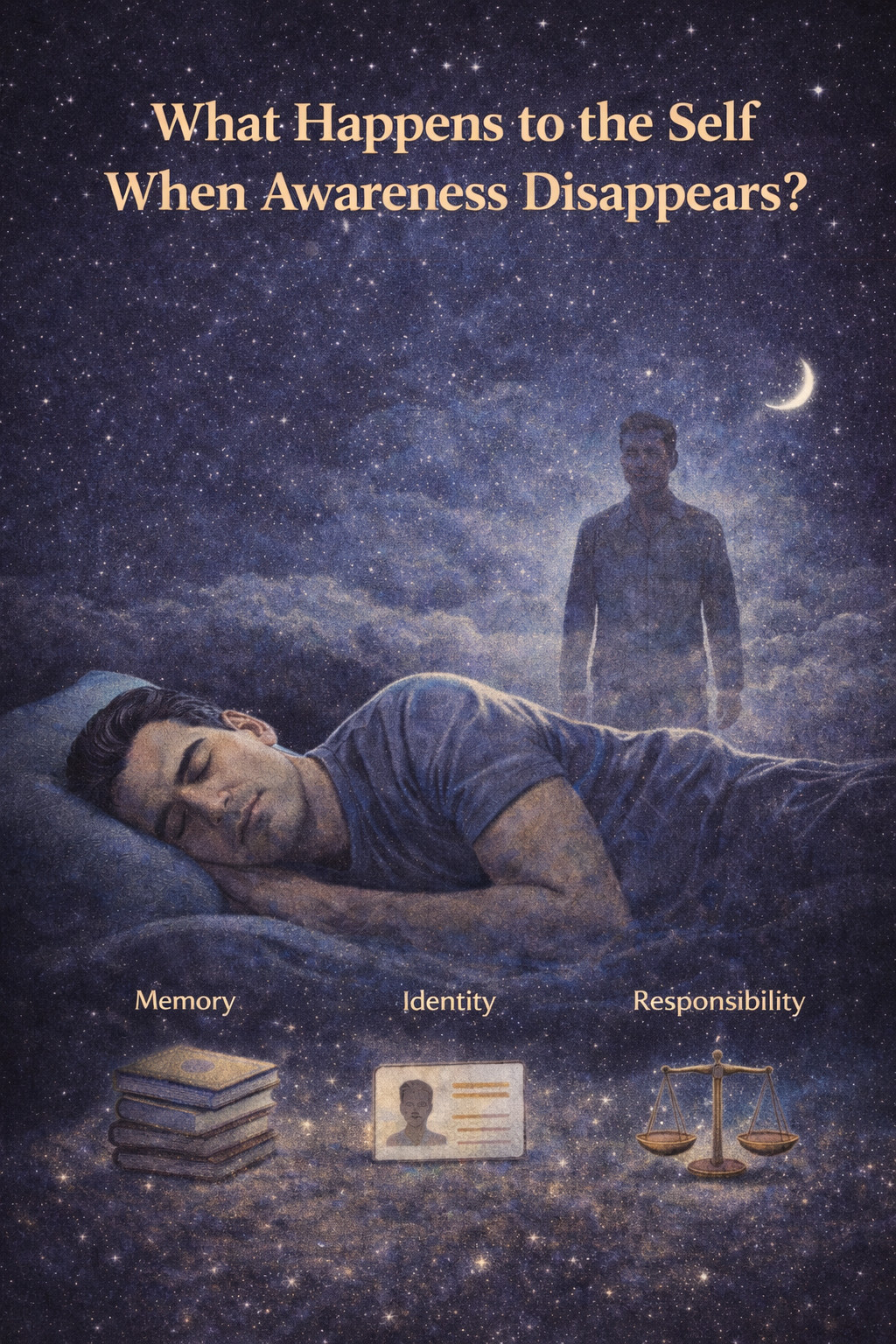
The central philosophical question sleep raises is simple yet profound: What happens to the self when awareness disappears? During deep sleep, the senses shut down, thoughts vanish, and time collapses, yet the person remains the same upon waking. Memory, identity, and moral responsibility continue uninterrupted. This everyday experience challenges the assumption that the self is identical with conscious thought.
Because sleep is universal and non-pathological, philosophers treated it as reliable evidence rather than an exception. It shows that awareness is intermittent, but being is continuous.
Islamic Philosophy: Sleep as Temporary Divine Custody
In Islamic thought, sleep is not merely biological rest; it is a real metaphysical event. The Qur’an describes God as taking the souls both at death and during sleep, retaining some and returning others. The difference between death and sleep is not in the act itself, but in its duration. Death is permanent retention; sleep is temporary custody.
This understanding implies that the soul does not belong to the body in an absolute sense. It exists independently and remains under divine authority even while the body lives. Sleep therefore represents a moment in which the soul’s governance over conscious faculties is suspended, though its existence is not.
Islamic philosophers such as Ibn Sina expanded this idea philosophically. He argued that when sensory input ceases during sleep, the soul turns away from the physical world toward the intelligible realm. Dreams arise from this shift. Some dreams are confused because the imagination interferes; others are clear because the soul receives knowledge directly, without sensory distortion. Sleep thus becomes a state in which truth is still accessible, though not equally to all.
Jewish Philosophy: Partial Ascent and Renewal
Jewish philosophy and mysticism approach sleep through the idea of partial withdrawal. The Talmud’s statement that sleep is “one-sixtieth of death” expresses this precisely. Something essential recedes, but not completely.
Kabbalistic thought explains this by describing the soul as layered. During sleep, the higher aspects of the soul ascend toward the divine realm, while the lower aspect remains with the body to sustain life. This ascent is not aimless wandering; it is a renewal process in which the soul reconnects with its source. Dreams are the faint impressions left behind by this ascent, translated imperfectly into imagery.
Sleep, in this view, is a nightly spiritual restoration rather than mere rest.
Hindu Philosophy: Dissolution into the Absolute
Hindu philosophy, especially in the Upanishads, presents a radically different understanding. Here, sleep is not described as ascent or travel, but as dissolution. In deep sleep, the individual self, with its desires and distinctions, disappears entirely. There is no awareness of self or world, yet existence remains.
This state is taken as philosophical proof that the true self is not the ego or conscious mind. The soul does not meet God as an object during sleep; it rests in God as its own ground of being. Individuality dissolves, but reality does not. Sleep reveals that consciousness is not fundamental—existence is.
Greek Philosophy: Internal Reorganization of the Soul
Greek philosophers treated sleep as a reconfiguration of the soul rather than a departure from the body. Plato described the soul as composed of multiple parts. During wakefulness, reason governs; during sleep, reason weakens and imagination and desire become active. Dreams reveal hidden tendencies within the soul, showing that reason is not the soul’s entirety but its regulator.
Aristotle refined this view by insisting that the soul itself never sleeps. Sleep, he argued, affects perception, not life. The soul continues its vital functions uninterrupted. Consciousness pauses, but the principle of life remains fully active. Sleep therefore demonstrates continuity beneath awareness.
Christian Philosophy: Persistence of the Soul Without Awareness
Christian philosophers such as Thomas Aquinas built on Aristotle’s framework. Aquinas held that the soul remains united with the body during sleep, even though intellectual activity pauses. If the soul depended on awareness for its existence, it would cease every night. Since it does not, sleep proves that consciousness is not the essence of the soul.
Here, sleep becomes evidence that identity is grounded in being, not in momentary awareness.
Prophetic Consciousness: Awareness That Does Not Sleep
Within this broad philosophical landscape, Islamic tradition introduces an important exception: prophets are described as sleeping physically while remaining inwardly conscious. An authenticated saying of the Prophet Muhammad ﷺ states, “The eyes sleep, but the heart does not sleep.” This is not metaphorical language. Classical scholars treated it as a precise description of prophetic awareness.
In Islamic philosophy, the “heart” refers to the center of higher perception—the faculty through which truth and revelation are received. When the text says the heart does not sleep, it means that while sensory perception and bodily activity rest, the deepest level of awareness remains uninterrupted.
Philosophically, this implies that consciousness operates in layers. Ordinary people rely mainly on sensory perception and mental activity. When these shut down during sleep, awareness collapses into dreams and fragmented imagery. Prophets, however, are said to possess a deeper mode of awareness that does not depend on senses or ordinary thought. What appears as imagination or vague thought in others exists for them as clear and truthful knowledge.
Historical Examples of Prophetic Awareness in Sleep
History within prophetic traditions illustrates this distinction clearly. The Prophet Muhammad ﷺ saw events in dreams that later unfolded exactly as seen, such as the peaceful entry into Mecca before it occurred. His dreams were treated as revelation, not symbolism.
The story of Prophet Ibrahim provides another example. When he saw in a dream that he was commanded to sacrifice his son, he did not treat it as a psychological image. He acted upon it as objective instruction. In ordinary experience, such a dream would be dismissed as emotional disturbance; in prophetic consciousness, it was truth.
Similarly, in Biblical tradition, Prophet Joseph’s dreams and interpretations were not personal fantasies but accurate insights into future events. What others saw as confusion became historical reality.
These examples show that the difference lies not in the content of dreams, but in the source of awareness receiving them.
Philosophical Meaning of the Prophetic Exception
This exceptional state does not contradict the general philosophy of sleep. It refines it. For ordinary humans, sleep suspends awareness and disrupts access to truth. For prophets, sleep suspends bodily function but not epistemic clarity. Their soul does not withdraw from truth because it is already oriented toward it.
This implies that consciousness is not a simple on–off switch. It exists in degrees. Most people lose awareness when the senses rest; prophets do not lose their highest awareness because it is not tied to the body.
Final Synthesis: What Sleep Ultimately Reveals
Across philosophies, sleep consistently separates awareness from existence. Some traditions describe ascent, others dissolution, others internal reorganization, and some deny the soul altogether. Yet all agree on one point: awareness can fade without destroying reality.
Prophetic consciousness represents the extreme case where awareness transcends biological limits. It shows that what is imagination for most can be truth for some—not because reality changes, but because the depth of awareness changes.
Concluding Reflection
Sleep is not emptiness.
It is a different mode of being.
For most humans, it is a retreat from awareness.
For prophets, it is rest without loss of truth.
And for philosophy, it is the quiet proof that existence is deeper than consciousness.









Wonderful. The topic remains, as it should, unresolved. Analysing phenomenon of sleep directly involves topic of belief in metaphysical existence.
In Vedic and puranic traditions soul is described as purush. More it associates itself with conscious thought more weak it becomes.